
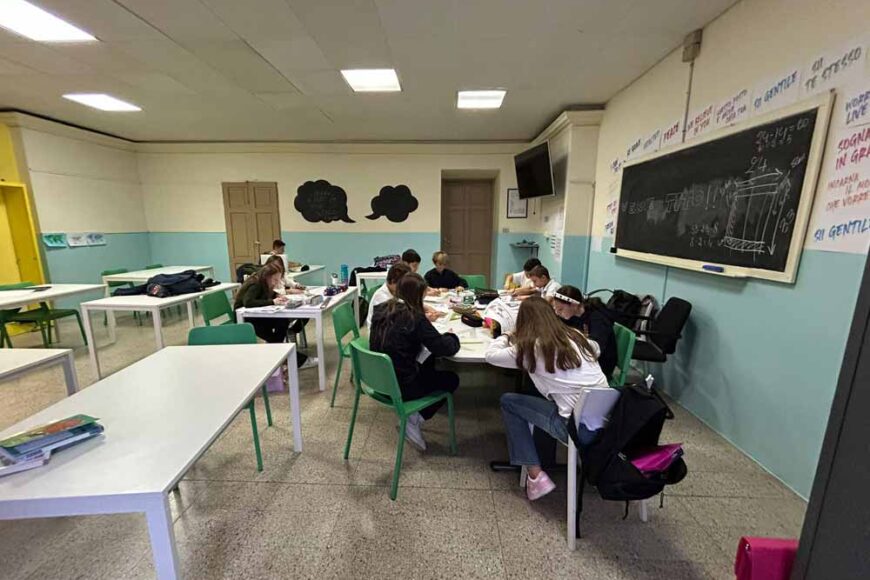
In the Friday issue of La Repubblica on September 19, 2025, Professor Raffaele Mantegazza, a professor of educational sciences at the Department of Medicine and Surgery at the University of Milan-Bicocca, where he teaches future doctors and psychotherapists, discovered that his students perform better when the exam is not individual but collective.
“It’s not a return to the para-revolutionary freak of the 1970s, nor even an anti-competitive flair, but a method for fostering young people’s creativity, their spirit of collaboration, and mutual support, as well as a valid antidote to the performance anxiety that puts students in crisis”.
Il professor Mantegazza sottolinea l’importanza del teatro come strumento per stimolare le idee. La creatività è centrale nel suo approccio didattico, ma con il tempo ha constatato che non è sufficiente.
Questo non è dovuto alla mancanza di impegno da parte degli studenti, ma piuttosto all’effetto disincentivante dell’intelligenza artificiale, che talvolta riduce la loro voglia di impegnarsi e influisce negativamente sulle prestazioni.
In his new method, or rather, his new exam format, the professor asks students to present a paper in pairs or groups, choosing a topic that spans the course texts. He gives them half an hour to freely and creatively express what they’ve studied, using, for example, drama, video, and techniques like collage.
This non-individual approach allows students to feel more comfortable and express themselves more effectively. He has noted that it leads to two positive outcomes: students devote themselves more seriously to their studies, as simple summaries found online are ineffective, and the exam becomes a true opportunity for collaboration, essential for preparing them for their future careers.
When the interviewer asks if there will be more individual exams and how grades will be assigned, Professor Mantegazza acknowledges that in some contexts, individual exams are appropriate, but emphasizes that his experience has demonstrated the effectiveness of group assessments.
Regarding assessment, he believes it currently weighs too heavily on students’ learning. Today, students feel driven by competition that risks undermining the school’s educational principles. In recent years, he has observed a worrying increase in anxiety: many students appear before the teacher visibly tense.
His goal is therefore to create a more relaxed environment, making exams the most rewarding moment of the entire course. During the year, the professor is the center of attention, but during group exams, he withdraws, leaving space for the students to share their work.
This situation always holds surprises, unlike standard questions, which have more predictable answers.
Furthermore, this new method brings out unexpected personal abilities: artistic, musical, and theatrical talents, as well as insights.
Professor Mantegazza’s reflections resonate strongly with the approach adopted for years in our schools: Pascal High School, Holden Middle School, and Daisy Elementary School.
His proposal for group exams, which foster a more welcoming environment and stimulate student creativity, perfectly parallels our commitment to collaborative work and active learning.
Lessons outside the classroom, library activities, and the promotion of creativity are central elements of our teaching practices. Just as Professor Mantegazza emphasized the importance of reducing anxiety and competition, we too have noted the fragilities and fears in our students, and we are working to erase them and replace them with creativity and self-confidence.
Our educational approach thus aligns with Professor Mantegazza’s vision, demonstrating that learning that encourages collaboration and creative expression is essential to preparing students for a future of success and personal fulfillment. In this spirit, we continue to foster a serene and stimulating educational environment, where every child can explore and develop their potential.

