
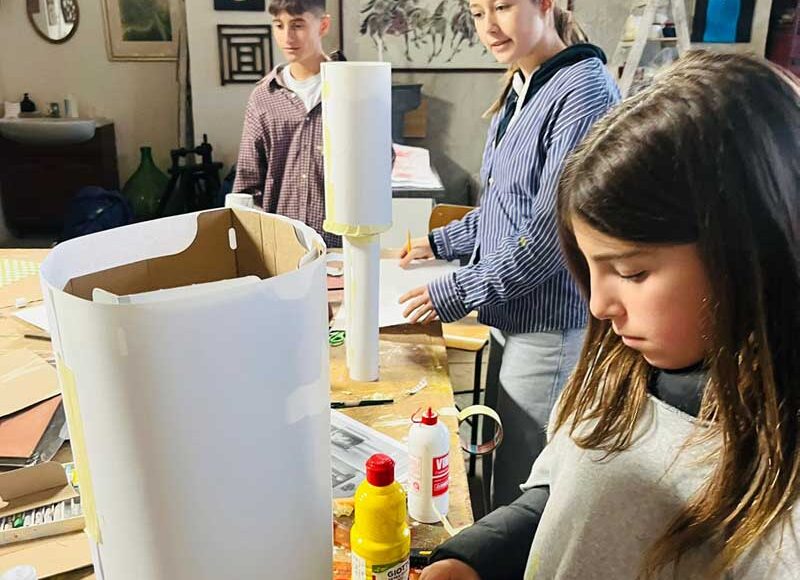
In recent years, attention to the emotional well-being of adolescents has grown significantly, emphasizing the importance of understanding and valuing their emotions. For several years, Holden Middle School in Chieri has addressed this need by integrating art therapy into its curriculum. This approach promotes a safe environment for expressing feelings and managing stress, thus fostering overall well-being and deeper learning for its students.
In recent months, a group of Holden students, led by Professor Ferri, has dedicated two hours each week to art therapy.
What is art therapy?
Art therapy is an expressive process that serves as a tool for self-discovery, using creative processes and artistic materials.
Artistic activity creates an opportunity for nonverbal communication, thus allowing emotions to express themselves, whether positive or negative.
Through shapes and colors, art therapy helps build a bridge between the inner world and the external world, offering listening and harmonizing both dimensions.
Growing up involves moments of vulnerability and difficulty, such as the arrival of a sibling, moving, or parental separation. The use of art materials offers a way to freely express emotions and distress, providing students with the tools needed to face the challenges of their journey.
How was Professor Ferri’s art therapy course structured?
The first part of the course focused on “Self-Knowledge.”
In this phase, students were guided to reflect on their identity, emotions, and personal characteristics. Art allowed them to represent themselves without the use of words, through shapes, colors, and symbols, fostering a first authentic connection with their “self.”
The second part of the course covered “The World Around Us.”
This phase explores the relationship between self and the external environment: family, school, peers, and society.
The central activity was the construction of a frame, a symbol of personal boundaries: what protects us, what we choose to show, the boundary between our inner world and the outside world.
The frame became a concrete metaphor for emotional and relational boundaries, helping students reflect on respect for themselves and others.
The third part of the course focused on “The World Inside Us.”
In this phase, the focus shifts to interiority: emotions, fears, desires, dreams.
Various expressive materials are used, including:
- salt dough, to model forms related to emotions
- painting materials, to work on color, gesture, and sensation
- free techniques to foster spontaneity and personal expression
Manipulating materials allows students to connect with their feelings in a concrete and reassuring way.
The art therapy project will continue throughout the school year, creating new graphic works that authentically reflect each student’s personality. The experience will conclude with installations in classrooms and hallways, expressive performances, and a final exhibition open to the city of Chieri.

