
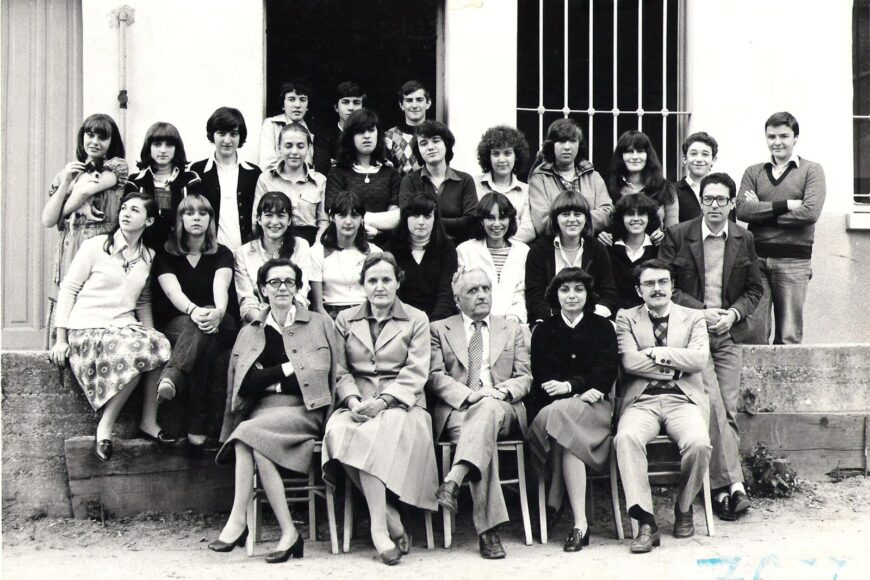
From the first class of eight students to today’s Institute, with a primary school, a lower secondary school and three upper secondary school programmes. On 27 November, a conference celebrating the 50th anniversary, a time capsule for students in 2076 and, on 11 December, an evening dedicated to the celebrations.
2026 marks an important anniversary for Licei Pascal in Chieri, founded in 1976 by Professor Gustavo Fino. Over the past fifty years, the school has gone through several phases, changes in management, expansions of its educational offering and relocations, eventually becoming today’s Pascal Institute, which comprises Daisy Primary School, Holden Lower Secondary School and Licei Pascal, now based on Via San Filippo in Chieri.
The origins: Professor Gustavo Fino’s vision
The history of Pascal began in 1976, when Professor Gustavo Fino, a humanities teacher who had also taught English at the Vittone Institute in Chieri, reached retirement age.
For some time, the professor had been planning to establish a private school together with several colleagues from the Vittone Institute who were also approaching retirement.
The founding members were Professor Gustavo Fino, his daughter Francesca Fino and accountant Merlone.
The organisational approach was unusual: rather than setting up a conventional private company, Fino decided to establish a workers’ cooperative.
According to the recollections of his daughters, Fabia and Francesca Fino, this may have been the first workers’ cooperative established in Italy to run a school, although this claim still requires documentary verification.
The founder had a clear vision of how a school should be organised. He considered the public education system excessively slow in its decision-making processes, describing it as a “pachyderm”, but he also disagreed with the model of private schools primarily focused on generating profits.
The cooperative offered an alternative: ensuring that employees were paid while reinvesting available resources in improving the school.
This model also made it possible to involve teachers who retained their positions in state schools while teaching at Pascal.
1976: eight students and two programmes of study
Pascal opened in the 1976–1977 academic year at premises in the Sant’Antonio area, near San Carlo, in Chieri.
The first class consisted of just eight students, divided between two programmes: the language-focused upper secondary school and the teacher-training institute.
According to the accounts of Fabia and Francesca Fino, the teacher-training programme probably followed a four-year curriculum.
Management during the early years was simple and family-run. Professor Fino’s wife handled the school’s administrative work directly from their home, even making the family telephone number available to receive enrolment enquiries.
The first student to enrol at Pascal was Giovanna Pengo, who later died at a young age in a road accident near the junction for Poirino. She was struck by a car as she was getting off a bus.
The opening of a language-focused upper secondary school represented a significant development for Chieri. In the 1970s, girls wishing to pursue this type of education had to travel to Turin, particularly to the Adorazione Institute. With Pascal, it became possible to attend a language-focused upper secondary school in the city itself.
The founder also chose the school’s name: Gustavo Fino selected “Pascal” because it was short, easily recognisable and unlikely to be mispronounced.
The expansion project between 1989 and 1991
In the following years, Chieri’s educational landscape began to change. The state-run Monti upper secondary school also introduced a language programme, becoming a competitor to Pascal.
Between 1989 and 1991, Professor Fino began working on a concrete expansion plan: opening a lower secondary school, followed by a primary school.
He believed that an upper secondary school alone would not be enough to ensure the Institute’s long-term development. Instead, he wanted to create an educational pathway that could accompany students from their first years of schooling all the way to graduation.
However, the project was not completed during the founder’s lifetime.
Gustavo Fino died in 1994, aged 79, while still serving as Pascal’s headmaster.
From 1994 to 2014: twenty years of change
Following the founder’s death, several headteachers and presidents succeeded one another at the helm of Pascal.
Over the years, different organisational and management strategies were adopted. As the Institute gradually encountered increasing difficulties, the decision was made in 2014 to put the school up for sale.
This marked a turning point in Pascal’s history.
In 2014, new ownership took over and launched a programme of reorganisation, investment and expansion of the school’s educational offering.
This initiative led to the creation of today’s Pascal Institute, comprising three educational establishments: Daisy Primary School, Holden Lower Secondary School and Licei Pascal.
In this way, without the new owners initially being aware of it, the Institute brought to life the very project Gustavo Fino had sought to develop between 1989 and 1991: bringing primary, lower secondary and upper secondary education together within a complete educational pathway.
The move to Via San Filippo and the growth of Licei Pascal
One of the most significant changes took place in 2014, when Licei Pascal moved to its current premises on Via San Filippo in Chieri.
The former premises in the Pace area had become too small to accommodate the different programmes of study. The move was therefore necessary to support the school’s continued development.
The former Pace premises are no longer part of the current Pascal Institute.
In the years that followed, the educational offering was progressively expanded. In the 2026–2027 academic year, Licei Pascal offers three programmes: the scientific lyceum, the language lyceum and the human sciences lyceum.
Particular attention is devoted to foreign language teaching and internationalisation.
The language lyceum also offers a programme in which Chinese is taught as a second foreign language within the core curriculum, complementing the other European languages.
Students can also pursue a dual Italian-American diploma, combining the Italian upper secondary school curriculum with a programme of study leading to an American high school diploma.
Licei Pascal is part of the Cambridge Assessment network, which supports the development of language skills through international certifications. The school is also connected with the Confucius Institute network through activities dedicated to Chinese language and culture.
These opportunities are complemented by international mobility experiences and Erasmus projects, which enable students to engage directly with other European educational environments.
Pascal’s growth, therefore, is not limited to expanding its range of programmes. It also involves providing students with educational pathways and qualifications that are recognised internationally.
The “Capitolo Cinquanta” conference on 27 November 2026
To celebrate fifty years since its foundation, Licei Pascal has organised a series of events beginning with the “Capitolo Cinquanta” conference on Friday, 27 November 2026, at 10:30 a.m.
The event will explore the history of the Institute, the changes that have taken place in the world of education and the prospects for schooling in the years ahead.
Representatives of public institutions, members of the education community and people who have contributed to Pascal’s development over the decades will take part.
The reconstruction of the school’s early history also draws on the accounts of Fabia and Francesca Fino, the founder’s daughters, who have helped recover stories, decisions and details from the Institute’s first years.
A time capsule hidden in a wall for students in 2076
The 50th-anniversary celebrations will also include the creation of a time capsule, which will be placed inside one of the Institute’s walls.
The capsule will contain a message addressed to the students who will attend Pascal in 2076, on the centenary of its foundation.
The aim is to preserve a snapshot of school life in 2026, including students’ studies, activities and aspirations, as well as reflections on how education might evolve over the following fifty years.
If discovered and opened in 2076, the capsule will allow future students to gain a first-hand insight into a part of school life as it is today.
The anniversary celebration at Ciliegi in Pecetto Torinese on 11 December
The celebrations will continue on Friday, 11 December 2026, at Ciliegi in Pecetto Torinese, with an evening dedicated to the 50th anniversary.
The event will bring together people connected with Pascal’s history, members of staff, representatives of public institutions and guests who have accompanied the Institute throughout its development.
The anniversary programme will offer an opportunity to look back on the school’s entire history, from its foundation in 1976 to the change in ownership in 2014 and its present-day organisation.
Fifty years after that first class of eight students, Pascal has become an educational institution encompassing three levels of schooling and three upper secondary programmes. Based on Via San Filippo, it offers a broad educational experience that includes the American dual diploma, Cambridge Assessment, Chinese language studies and international partnerships.
This achievement reflects the journey undertaken since 1976 and provides a starting point for the Institute’s next chapter.

