
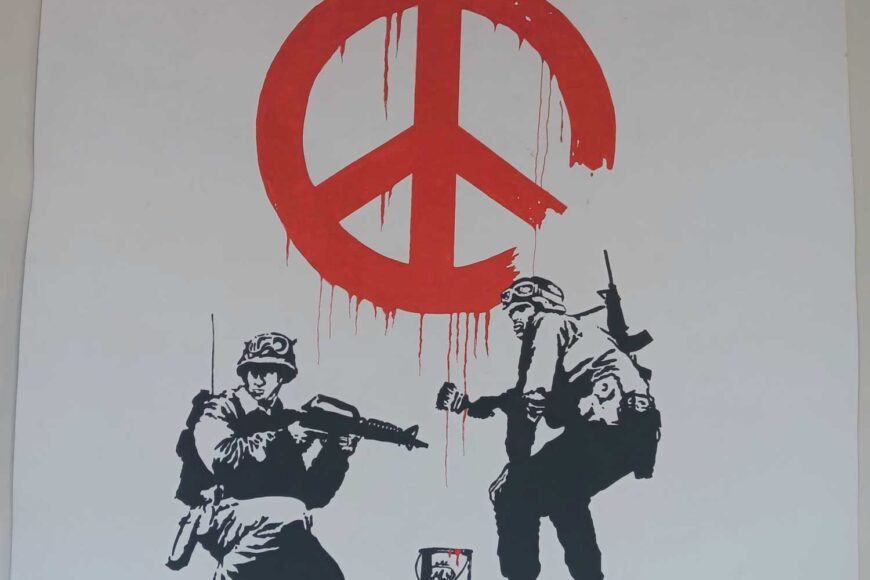
There’s a lot of talk about peace these days. Indeed, everywhere you turn, there’s conflict: Ukraine, the Middle East, Sudan, Somalia, Indochina… and in a thousand other places we may not even know about. TV announcers chant for peace, newspapers describe war and hope for an imminent peace, bloggers, influencers, and Big Brother inmates call for peace.
The concept of peace has become a brand, a sound emptied of its true meaning. Every term, if abused and violated, loses its meaning. But if the term in question were a harmless one like summer, peach blossom, or hammer, there would be no need to be alarmed! The word “summer,” stripped of its meaning, wouldn’t harm anyone; vacations would continue to be a carefree moment of lightheartedness and anticipation. Not to mention the hammer: for a blacksmith, a hammer would continue to be a hammer, even if bloggers around the world made it the most desired object among young Westerners. Unfortunately, this isn’t the case with the word “peace.”
The news rolls over us without a trace. Knowing that 100 children have died in Iran and that peace is far away is as moving as an advertisement for gluten-free pizza.
The term “peace” has been emptied of its meaning; it has become a sound without meaning. Perhaps we should ask ourselves: how can we restore language to its original form? We need to reconsider language in its communicative sense, where the meaning of each term is inseparable from its use. In short, we should think before we speak, weigh our terms, use a dictionary, and brush up on the true meaning of every word we’re about to utter. It’s essential to teach children the value of words.
On the one hand, the world of social media allows us to use light, clipped language, sometimes far from dictionary definitions, but on the other hand, we must remember that communication outside of social media must continue to follow strict rules: an article must convey content, a news program must deliver news, avoiding unnecessary turns of phrase. In pre- and post-election evening chats, the gentlemen invited to speak must have substance and abstain if they are unprepared. Idle words disturb and annoy… silence is better than a speech without content!
I close this article with a provocation: I invite all readers of this blog and all students at the Pascal Institute to pick up their Italian dictionary and, every evening, read the meaning of at least 10 words, starting with the word “peace.”

