
Sunday: We’re packing our bags and, with some regret, we’re leaving Finland. We bid a final farewell to the milky sea visible from our windows, to the gray sky, and to the people of Helsinki, who, silent, orderly, and generous, welcomed us and revealed the secrets of their culture, of a population that, according to recent articles, is the happiest in the world.
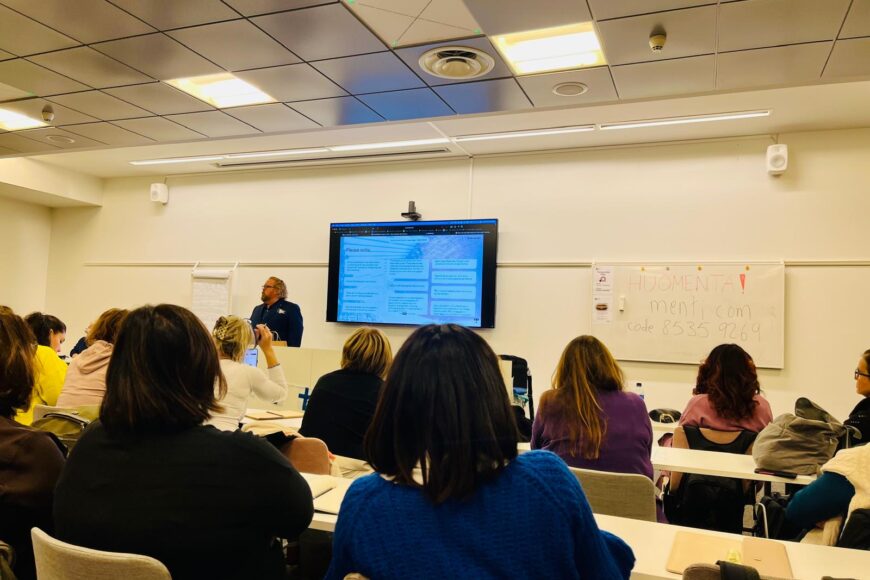
What did our trainer Petri teach us this week? With colleagues, in the evenings, over salmon soup, we talked about school, about improvements, about the idea of a new school system, sometimes different from the one we’re experiencing in Italy and sometimes our own Italian school. Because our school system isn’t to be thrown away, as it’s described and as we read in newspapers, interviews, and false commentators on social media.
Recently, Gianrico Carofiglio wrote an interesting and witty article in Repubblica titled “Courage and Kindness: The Allies of Democracy.” I quote the opening line: “The fundamental principle of jujutsu—but also, in different ways, of many martial arts such as judo, aikido, karate, and Wing Chun—is about using the opponent’s strength to neutralize aggression and, ultimately, to eliminate or reduce the violence of the conflict. If the attacker pushes you, you yield, pivot, and knock him off balance; if the attacker pulls, you push and, in the same way, knock him off balance.”
I can see between the lines the lessons taught to us by Petri, our trainer. The takeaway from the mornings with Petri can be summed up in a few terms, always with a positive connotation: dialogue, discussion, trust, kindness, collaboration, a positive outlook, and the absence of conflict. In his article, Gianrico Carofiglio urges us to address conflict by avoiding it: “There is no use of unnecessary violence; the neutralization of the attack, the imbalance created by the displacement and diversion of aggressive force, have a defensive function, but also an educational one. They show the adversary in a gentle way—let’s say, in the gentlest way possible—that aggression is useless and harmful, and backfires. Neutralizing the attack does not imply eliminating the adversary.”
Carofiglio continues by saying that these principles must be brought back to dialectics, especially to the political and institutional confrontations we see every day on TV, which are counter-educational and charged with aggression. Reading Carofiglio and having Petri’s lessons clearly in mind, I feel compelled to say that this dialectic of kindness must be brought back to the classroom.
Petri taught us to greet our students in the morning with a smile, asking how they are, even when we have a thousand things to worry about, like filling out the electronic register, absences, homework, and tests. Petri taught us to collaborate with our colleagues, to avoid conflict, inferiority, or superiority; he taught us to work as a team and told us that competition is pointless.
It’s true that this is pure theory, but when we gathered with our colleagues, some from other schools in Italy, others from across Europe, we were happy, just like all Finns. Petri taught us that teamwork creates a circle of trust. Just like a stone thrown into water, each circle degenerates into another.
When teachers collaborate and support each other, this spirit of trust and cohesion is also reflected in the classroom, creating a positive climate that encourages students to actively participate and see the value of learning.
Therefore, every step we take together, every innovative practice we adopt, becomes a living example for our students. It is through these concrete actions that we can instill in our students a desire to learn and to commit to their educational journey. School is not only a place for the transmission of knowledge, but also an environment where examples of collaboration and trust can motivate and inspire every student to give their best.
I thank Petri and all the colleagues I have met; I am sure we will meet again and stay in touch, striving to put into practice everything we have learned in our schools. I thank the Erasmus program for allowing us to bring such a wonderful experience to our students.

