
In recent years, speaking with many parents, I’ve realized something very clear: school, as it has been for generations, is no longer enough. Filling notebooks with notes isn’t enough, “finishing the program” isn’t enough, and getting home a grade isn’t enough. More and more mothers and fathers, especially those of children between the ages of six and thirteen, are demanding something different. They want a school that cares for their children, that helps them grow as people, even before they grow as students.
It’s precisely from this need that the Holden Middle School in Chieri embarked on the path it took, an institution that long ago decided to challenge itself and look beyond Italy’s borders. Its inspiration? The famous Finnish model, often cited as one of the most effective educational systems in the world.
But what does “taking inspiration from Finland” really mean? It’s not a matter of copying timetables or textbooks. It’s rather a change in mentality.
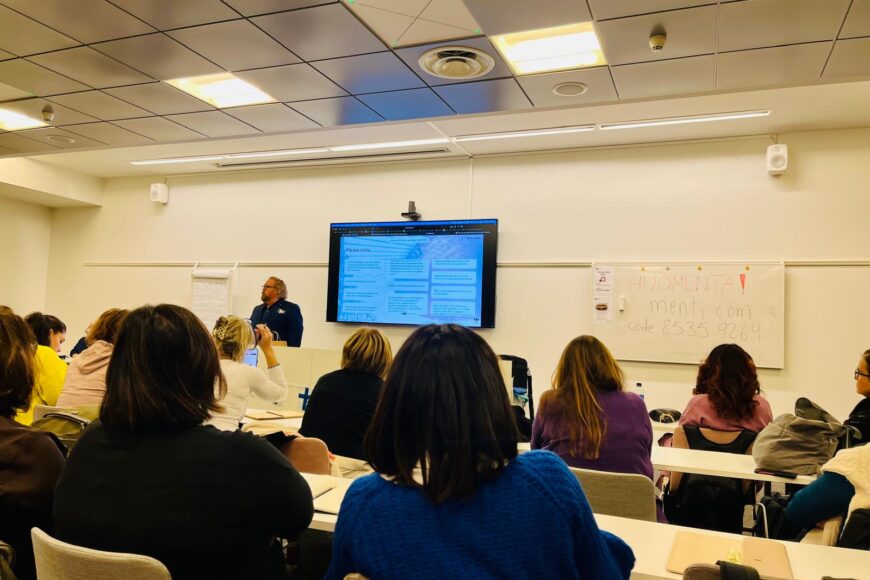
In recent months, eight teachers from Holden flew to Helsinki for an intensive ten-day course. Not just a simple visit, but a total immersion in a different way of understanding school. They observed, studied, asked questions, challenged ingrained habits. And they returned with one certainty: teaching doesn’t mean speaking for an hour in front of a silent class.
One of the key concepts they brought home is flexibility. In Finland, there’s no “rigid” lesson that’s the same for all classes. It starts with the students: their attitudes, the group’s energy, the dynamics that develop day by day. The teacher becomes a careful guide, capable of adapting the curriculum based on the individual.
Another striking aspect is the value of communication between colleagues. There’s no such thing as a closed door or a teacher isolated in their classroom. We work together, sharing methods, doubts, and difficulties. We openly discuss students’ critical issues to find common solutions. It’s a culture of collaboration that puts trust at its core.
And then there’s a topic that’s almost laughable in its simplicity: movement. Why abandon the traditional, frontal lesson? Because students need to move. It’s not just a matter of restlessness: studies show that just twenty seconds of physical activity activates certain areas of the brain linked to concentration and memory. This means that getting up, changing seats, or engaging in a brief, dynamic activity can improve attention and even test performance.
In Finnish schools, it’s common to interrupt lessons to do a short movement exercise, or to work standing up, or to move to another space. Classrooms aren’t static environments, but flexible spaces. Even the outdoors becomes a place of learning. Repositioning desks, going out into the courtyard, and alternating contexts all contribute to maintaining curiosity.
Upon returning from Finland, the Holden teachers began introducing small but significant changes. For example, they devoted more time to exchanges at the beginning and end of classes. A few minutes to ask: “How are you? What did you remember from yesterday’s lesson? What was difficult for you?” They slowed down their pace, choosing to delve deeper into certain topics rather than rushing to cover the entire syllabus.
And this is where perhaps the most powerful reflection emerges: does the quantity of knowledge taught really matter, or its quality? For years, many teachers have lived with the anxiety of “finishing the book.” But if students forget everything after a few weeks, what’s the point? The Finnish model suggests a different perspective: less content is better, but it’s better to understand it thoroughly, connect it to reality, and internalize it.
Of course, no one thinks the Italian system can become identical to the Finnish one overnight. The cultural, organizational, and economic differences are evident. Finland can count on more extensive public funding and a historically different approach. However, this doesn’t prevent the import of good practices: a climate of trust, collaboration between teachers, attention to students’ emotional well-being.
At Holden, they’re working on precisely this: creating a “circle of trust” involving teachers, students, the principal, and families. Because the school is not an island. When parents feel part of the educational project and teachers feel supported by the management, the environment changes. There’s less stress, more listening, more shared responsibility.
After all, the real revolution isn’t moving desks or taking an active break. It’s changing perspective. Moving from the idea of school as a place of simple education to that of a community that forms aware citizens, capable of facing the challenges of the European and global future with skills, yes, but also with balance.

